
Nitrogen Generators for Laser Cutting: How to Choose the Right Purity, Pressure & Flow
October 08, 2026
Not every nitrogen generator can support laser cutting. Laser cutting places demands on a gas supply that most general-purpose nitrogen systems were never engineered to meet — and when the supply falls short, it shows up directly in your edge quality, your throughput, and your operating costs.
The good news: on-site nitrogen generation solves the problem completely, if the system is sized and built for the application. This guide walks through exactly what laser cutting requires from a nitrogen system — purity, pressure, flow, storage, and filtration — how to size those requirements to your material and machine, and how GENERON, as the manufacturer, builds systems specifically for the job.
What laser cutting demands from a nitrogen system
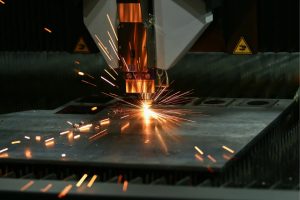
In laser cutting, nitrogen is an assist gas. It clears molten material from the kerf and shields the cut edge from oxygen, producing the clean, bright, oxidation-free edge that nitrogen cutting is prized for. Because the gas is doing mechanical and chemical work at the cutting head, the supply has to hold steady on four fronts at once:
- Purity determines edge chemistry. Higher purity means less oxidation and less discoloration — and less secondary finishing downstream.
- Pressure does the physical work of blowing molten metal out of the kerf. Thicker material and faster cutting need more of it.
- Flow has to keep up with the head throughout the entire cut, especially when multiple machines run at once. When flow can’t keep up, pressure sags — and cut quality goes with it.
- Storage buffers the peaks. Laser demand is spiky; storage lets the system ride through surges without the generator having to chase every fluctuation.
Miss on any one of these and you get the same symptoms: inconsistent edges, scrap and rework, slower cycles, and higher cost per part. A nitrogen system for laser cutting has to deliver all four together — which is a manufacturing problem, not an assembly problem.
Purity, pressure, and flow are one system — not three specs
Buyers often shop on purity alone. Purity matters, but it’s one leg of a three-legged stool. The cleanest nitrogen in the world won’t save a cut if pressure drops mid-kerf or flow can’t feed a second laser coming online.
Modern fiber lasers depend on high-pressure nitrogen to eject molten material fast enough to keep up with cutting speed. That pressure is only useful if flow can sustain it through the whole cut cycle — and through peak periods when several heads draw at once. And purity is what turns a completed cut into a finished edge that doesn’t need grinding or pickling.
The right question isn’t “how pure?” It’s “does this system hold purity, pressure, and flow together, under my real production load?” That’s the spec that separates a purpose-built system from a repurposed one.
How much purity, pressure, and flow do you actually need?
This is where most vendor content goes quiet. Here’s a practical starting point by material and thickness. Treat it as a sizing conversation-starter — your material grade, machine, nozzle, and cut speed all move these numbers, which is exactly why we size every system to your actual application rather than selling a fixed box.
|
Material & thickness |
Typical N₂ purity |
Typical head pressure |
Notes |
|
Mild steel (thin, N₂ finish) |
99.5%+ |
Lower band |
Often cut with O₂; N₂ used for oxide-free edge |
|
Stainless steel (thin gauge) |
99.9%+ |
Mid band |
Edge brightness sensitive to purity |
|
Stainless steel (plate) |
99.9%–99.999% |
High band |
Thick stainless is the most demanding case |
|
Aluminum (sheet to plate) |
99.9%+ |
Mid–high band |
High flow; dross control depends on pressure |
The pattern to remember: thicker and shinier pushes you toward higher purity and higher pressure — and toward more flow and more storage to sustain it. A system sized for thin-gauge stainless will choke on aluminum plate. This is why “any nitrogen generator” is the wrong frame, and why the sizing should be done by an engineer who has the full performance data in front of them.
Membrane or PSA? The right technology depends on your shop
There are two proven ways to make nitrogen on-site, and the right one depends on your purity target, footprint, and duty cycle. GENERON manufactures both — so the recommendation is driven by your application, not by the one product a vendor happens to sell.
Membrane generation passes compressed air through hollow-fiber modules; oxygen and water permeate out through the fiber walls while nitrogen flows down the bore and out as product. It’s compact, low-maintenance, fast-starting, and excellent for continuous duty. GENERON’s HollowPure™ membranes now reach purities up to 99.9% — a range that used to require PSA.
PSA (Pressure Swing Adsorption) uses adsorbent beds to strip oxygen from compressed air, and it’s the tool of choice when you need the very highest purities. GENERON’s CleanSorb™ PSA systems reach up to 99.9995%.
|
|
Membrane (HollowPure™) |
PSA (CleanSorb™) |
|
Purity |
95%–99.9% |
95%–99.9995% |
|
Footprint |
Very compact |
Compact, indoor-rated |
|
Start-up |
Near-instant |
Requires stable inlet conditions |
|
Best for |
Continuous duty, tight spaces, mobile |
Highest-purity edge work |
A fab shop running mixed material may be best served by one technology, the other, or a hybrid line. Because we build both, we’ll tell you which — even when the answer is the less expensive one.
GENERON’s laser-cutting nitrogen range
Rather than a single SKU, GENERON offers a full capacity spectrum and engineers the package — generation, boosting, storage, and filtration — to your load.
|
System |
Purity |
Flow |
Pressure |
Where it fits |
|
NOW Panel (Nitrogen On Wall) |
99.5% |
~4 SCFM |
Wall-mount |
Entry / light-gauge single-laser cells; minimal footprint, near-silent |
|
Modular PSA (NG Series) |
95%–99.999% |
61–7,389 scfh |
— |
Scalable indoor generation; U.S. Patent No. 12,551,838 B3 |
|
PSA line |
up to 99.9995% |
to 2,030 scfm (3,200 Nm³/h) |
— |
50+ standard models; highest-purity, high-volume shops |
|
High-Pressure Membrane (GHP) |
97%–99.9% |
Model-dependent |
up to 5,000 psig |
High-pressure applications; one of the smallest footprints on the market |
|
Containerized / mobile |
97%–99% |
to 1,600 cfm |
290–300 psig |
Turnkey high-flow delivery in an ISO container |
Every laser-cutting package is completed with the components that keep the supply stable: high-pressure boosting, ASME-coded storage to buffer demand peaks, and multi-stage filtration (coalescing and activated-carbon) to protect both gas quality and the laser head — a component far more expensive to replace than a filter element.
Why buy from the manufacturer — not a big-box assembler
Plenty of companies will sell you a nitrogen system. Very few manufacture one. The difference matters when the system has to perform for years on a production floor.
GENERON engineers and builds the core separation technology in-house:
- We make the membranes. HollowPure™ hollow-fiber modules — over a million fibers per module — developed and produced in our own R&D and manufacturing facilities.
- We make the PSA. CleanSorb™ adsorption systems, machined from heavy-duty aluminum with integrated manifolds that cut leak points and boost yield — and protected by U.S. patent.
- We make the storage. ASME-coded pressure vessels, built in-house — so the buffer that stabilizes your supply comes from the same manufacturer as the generator.
- Made in the USA, under ISO-9001-certified design and manufacturing, since 2002.
That vertical integration is the real answer to “integrated vs. pieced-together.” A big-box supplier integrates components — often sourced from third parties — into a cabinet. GENERON manufactures the components themselves. One manufacturer, one point of accountability, one engineering team that understands the system from the fiber up. When you call for support, you reach the people who built it.
On-site generation vs. bulk delivery
If you’re still buying liquid nitrogen or cylinders, on-site generation typically pays back fast. It removes delivery schedules, rental and hazmat handling, and exposure to escalating gas contracts — and it frees the floor space that bulk storage consumes.
The savings are real: on-site nitrogen generation commonly delivers 50% to 300% cost savings compared with bulk liquid, dewar, and cylinder supply. You produce nitrogen when and where you need it, at the purity your lasers require, with no truck to wait on.
Sizing your system
The single most important step is right-sizing — purity, pressure, flow, and storage matched to your material mix, machine count, and duty cycle. That’s a conversation with an application engineer, not a line item in a catalog.
Tell us what you cut and how much, and a GENERON engineer will size a system to it.
Frequently asked questions
What nitrogen purity is needed for laser cutting? It depends on material and edge requirements. Many stainless and aluminum applications target 99.9% or higher, with the most demanding thick-stainless work benefiting from purities up to 99.999%. Thin mild steel can run lower. GENERON systems cover 95% to 99.9995%, sized to your specification.
What pressure does nitrogen laser cutting require? Pressure rises with material thickness and cut speed, since the gas has to eject molten metal from the kerf. Thin gauge runs at lower pressure; thick plate demands high pressure. GENERON high-pressure systems reach up to 5,000 psig, and laser packages are boosted and stored to hold pressure steady under peak demand.
Should I choose a membrane or PSA nitrogen generator? Membrane systems are compact, low-maintenance, and ideal for continuous duty up to 99.9% purity. PSA systems reach the highest purities, up to 99.9995%. GENERON manufactures both and recommends based on your application.
Can I generate nitrogen on-site instead of buying bottles or liquid? Yes. On-site generation removes deliveries, rentals, and supply contracts, and commonly saves 50%–300% versus bulk liquid and cylinders — while freeing floor space.
How much floor space does a nitrogen generator need? Less than most shops expect. GENERON’s high-pressure membrane units have one of the smallest footprints on the market and are designed to sit on the production floor; the NOW Panel mounts to a wall.
Who do I contact to size a system? A GENERON application engineer will size purity, pressure, flow, and storage to your material mix and machine count. Call +1.713.937.5200 or request a quote.